

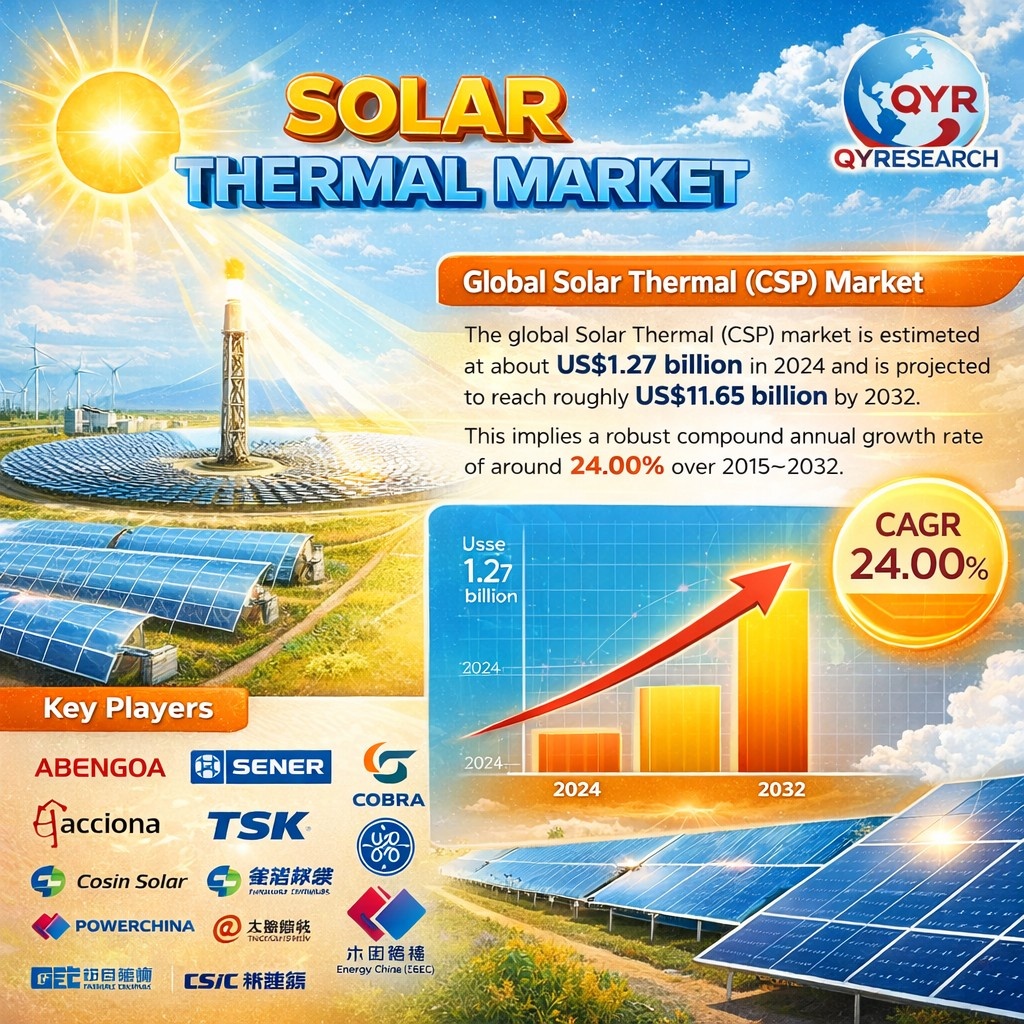
Global Solar Thermal (CSP) Market Outlook to 2032: Revenue Forecast at Approximately US$ 11.65 Billion with ~24% CAGR
Solar Thermal Market
Global solar thermal market to experience strong growth through 2032, driven by rising demand in industrial and residential heating.
PUNE, MAHARASHTRA, INDIA, February 2, 2026 /EINPresswire.com/ -- Pune, India: The solar thermal market encompasses technologies that harness the sun’s heat for practical use – from heating water and buildings to driving industrial processes and even generating electricity. Unlike solar photovoltaics (PV) which directly produce electricity, solar thermal systems capture solar heat energy using collectors (such as flat-plate, evacuated tube, or concentrating mirrors) and transfer it for various thermal applications. This market has matured from early niche uses to a diverse array of applications across residential, commercial, and industrial sectors.As of 2024, the global solar thermal market is valued around US$ 1.27 billion, reflecting widespread installations of solar water heaters, space heating systems, and several large-scale thermal power projects. Looking ahead, market forecasts indicate a compelling growth trajectory through 2026-2032. Analysts expect global solar thermal revenues to climb steadily at a high single-digit to low double-digit compound annual growth rate (CAGR) over this period. Under optimistic scenarios, the market could approach US$ 11.65 billion by 2032, nearly tripling in size from its mid-decade level. This growth outlook underscores the rising importance of solar thermal solutions in the global clean energy landscape. Both industrial process heat applications and residential/commercial heating solutions are slated to contribute significantly to the expansion, as consumers and industries seek sustainable alternatives to fossil-fuel-based heat sources.
Market Key Drivers
Several key factors are powering the strong growth and investment in the solar thermal market:
Decarbonization and Climate Policies: Governments worldwide are enacting policies to reduce carbon emissions and promote renewable energy. Targets for greenhouse gas reduction and programs like renewable heat incentives are encouraging the switch from coal, oil, and gas heating to solar thermal systems. The push for net-zero emissions by mid-century has elevated solar thermal’s role in providing clean heat for buildings and industry.
Rising Energy Costs & Security: Volatile fossil fuel prices and concerns over energy security are driving interest in solar thermal technology. Businesses and homeowners are increasingly motivated to install solar thermal systems to hedge against high heating fuel costs (such as natural gas, heating oil, or electricity) and to ensure a more reliable, local energy supply. Sunlight is a free and abundant resource in many regions, making solar thermal an attractive long-term investment with lower operating costs.
Technological Advancements: Continuous improvements in solar thermal technology have boosted performance and cost-effectiveness. Modern evacuated tube collectors and high-efficiency flat plate collectors can capture more heat even in cooler or cloudy climates, expanding the viable markets for solar thermal. On the high end, concentrated solar thermal systems with advanced mirrors, tracking, and thermal storage (like molten salt) are gaining renewed interest for industrial heat and power generation. These innovations improve the reliability, lifespan, and output of solar thermal installations, enhancing their economic appeal.
Industrial Process Heat Demand: A significant emerging driver is the use of solar thermal in industrial processes. Many industries (food processing, textiles, mining, chemicals, etc.) require substantial heat input. Solar thermal systems can supply medium to high-temperature heat for factories, helping companies reduce reliance on natural gas or coal boilers. As corporations set sustainability goals and carbon pricing looms in some jurisdictions, solar heat for industrial processes is becoming a viable solution. Successful pilot projects in sectors like brewing, dairy, and manufacturing have demonstrated the feasibility of integrating solar thermal into industrial operations, spurring further demand.
Urbanization and Emerging Markets: In developing regions, rapid urban growth and rising living standards are increasing the need for hot water and comfortable indoor climates. Solar thermal offers an efficient way to meet this demand without a surge in fossil fuel consumption. Countries in Asia, Latin America, and Africa with abundant sunshine are ramping up adoption of solar water heaters for homes and solar thermal systems for community facilities. Government programs in several nations provide subsidies or mandates for solar water heating in new buildings, significantly driving market uptake.
Supportive Incentives and Regulations: Many governments offer incentives such as tax credits, rebates, or grants for installing solar thermal systems. Building codes and renewable energy mandates (for example, requiring a portion of building heat to come from renewable sources) also propel the market. In the commercial sector, green building certifications and consumer preferences for sustainable businesses are encouraging hotels, hospitals, and other facilities to utilize solar thermal for water heating and space conditioning. These policy and market signals collectively stimulate investment across the solar thermal industry.
Regional Insights
The solar thermal market is truly global, but growth and adoption rates vary by region due to climate, policy, and economic factors. Asia-Pacific is the indisputable leader in solar thermal deployment, accounting for the largest share of global installations and market revenue. In particular, China has been the dominant market – at one point representing well over half of worldwide solar thermal capacity, thanks to decades of government promotion of residential solar water heaters. China’s market growth has moderated recently as urban markets approach saturation, but it continues to install vast numbers of systems and is pivoting toward larger-scale applications (like solar district heating and industrial projects). Other Asia-Pacific countries such as India are also significant contributors, with India promoting solar thermal for both homes and factories as part of its renewable energy strategy. Overall, Asia-Pacific is estimated to hold nearly half of global market share, and it remains a region of high potential given its sunny climate zones and expanding energy needs.
Europe holds the second-largest regional market share, roughly around one-fifth of the global solar thermal market. European countries have a strong policy push for renewable heating in pursuit of climate goals and energy independence. Nations like Germany, Greece, Spain, and Turkey have longstanding solar thermal markets for water and space heating. In recent years, Europe’s growth has been especially notable in solar district heating – large centralized solar thermal farms that supply heat to multiple buildings or even whole communities. Countries in Northern and Central Europe (including Denmark, Sweden, Germany, Austria) are investing in these district systems, often integrating them with seasonal thermal storage to capture summer sun for winter use. Additionally, the European Union’s directives for renewable energy in heating (and initiatives like the Green Deal) are boosting adoption across both residential and commercial segments. Even regions with moderate climates, such as the UK and the Netherlands, are seeing increased interest as technology improves and as policies (like renewable heat incentives) make solar thermal more cost-competitive.
North America is another important region with growing solar thermal activity, though it currently trails Asia and Europe in market size. In the United States and Canada, solar thermal has historically been a smaller niche (with some popularity in sun-rich states like California, Arizona, and Florida for pool heating and domestic hot water). However, the landscape is changing with new incentives: for instance, the U.S. offers an Investment Tax Credit (ITC) for solar thermal installations, and various states have introduced rebates and requirements for solar heating in certain building types. These measures, along with rising consumer awareness of renewable heating and higher utility costs, are driving new demand. North America’s market is expected to see a healthy uptick in the forecast period, focusing on both commercial applications (such as hotels, hospitals, multifamily housing adopting solar thermal) and niche industrial uses (like agriculture and food processing facilities). The region’s share of the global market is likely to rise gradually as these projects multiply, though it remains behind Europe and Asia-Pacific in the near term.
Latin America and the Middle East & Africa (MEA), while currently smaller contributors in terms of market percentage, represent high-growth regions for solar thermal. In Latin America, countries such as Brazil and Mexico have accelerated adoption in recent years. Brazil, for example, has seen double-digit growth in solar water heater installations, driven by efforts to localize manufacturing and reduce electricity strain. Mexico’s combination of high solar irradiance and supportive policies at federal and state levels has led to a burgeoning market, with solar thermal increasingly used in both homes and businesses (often in hybrid setups with heat pumps to maximize efficiency). Other nations in Latin America (Chile, Argentina, etc.) are also exploring solar thermal for industrial process heat and rural development.
In the Middle East & Africa, the abundant sunshine makes solar thermal extremely promising. Several Middle Eastern countries (like Saudi Arabia, United Arab Emirates) are investing in large concentrated solar thermal power plants and water desalination projects using solar heat, as part of diversifying their energy mix. At the same time, in regions of Africa and South Asia, simple thermosiphon solar water heaters are a cost-effective solution for communities without reliable electricity or gas infrastructure. MEA’s overall market share is still modest, but pilot projects and new government initiatives indicate a strong growth curve ahead. For instance, South Africa and Kenya have launched programs to install solar thermal systems in industrial parks and institutions to cut fuel costs. Across these emerging markets, the combination of high solar resources and growing energy demand sets the stage for solar thermal technology to leapfrog traditional heating methods.
Competitive Landscape
The competitive landscape of the global solar thermal industry is diverse and evolving. Unlike some industries dominated by a few giants, the solar thermal market features a mix of regional players and international companies, and the competitive dynamics can differ by segment and geography:
In the residential and commercial solar thermal segment, especially for water heating, competition tends to be fragmented and localized. Numerous manufacturers around the world produce solar collectors and system components, often catering to their domestic or regional markets. For example, Chinese and Indian manufacturers supply a huge volume of affordable solar water heating units in Asia; likewise, Europe has several established solar thermal equipment companies known for quality and efficiency. This fragmentation means no single company holds an outsized global market share in the collector manufacturing space – instead, there are many small to mid-sized companies, as well as a few larger firms, each vying for market share in their focus regions. Competitive factors in this space include product cost, durability, efficiency ratings, and after-sales service networks. Because transportation costs can be significant for bulky solar panels and tanks, local production and distribution often provide an edge, leading to regional clusters of competitors.
On the other hand, the large-scale solar thermal and CSP segment sees involvement from more prominent energy companies and specialized engineering firms. Companies that develop and build solar thermal power plants or large industrial systems often have significant capital and technical expertise. This segment has a more consolidated competitive field, with a handful of key players (including some well-known renewable energy developers) that have delivered the majority of utility-scale solar thermal projects globally. Competition here revolves around technological capabilities (e.g., proprietary collector designs, storage integration, project management skills) and the ability to secure financing for multi-million-dollar installations. Because these projects are often done via government tenders or partnerships, having a strong track record and global reach is advantageous. That said, new entrants – such as startups with innovative collector technology or storage solutions – continue to appear, aiming to disrupt with lower costs or higher efficiency.
Overall, the solar thermal market’s competitive landscape can be described as moderately competitive with increasing innovation. Profit margins in the commodity end of the market (like basic water heaters) can be slim, driving manufacturers to optimize their supply chains and often compete on price. In contrast, the higher end of the market (custom industrial systems, IP-heavy CSP technology) competes more on performance and reliability metrics. Across the board, companies are focusing on innovation to differentiate themselves.
From an investor perspective, this landscape means there is ample room for growth and new players, but also a need to identify those firms with sustainable advantages. As the market grows toward 2032, we may witness some consolidation (mergers or acquisitions) where larger companies absorb smaller ones to enhance their product portfolios and global distribution. We may also see adjacent industries (for example, heat pump or insulation manufacturers) enter the solar thermal space, attracted by the synergies in providing comprehensive energy-efficient heating solutions.
In summary, competition in the solar thermal arena is healthy, spurring continuous improvements. Customers benefit from a wider selection of products at better prices, while companies that can innovate and scale are positioned to ride the market’s growth. The race is on to provide the most cost-effective and reliable solar thermal solutions, and that race will ultimately accelerate the technology’s adoption worldwide.
For further details on the “Global Solar Thermal Market” report, including full data and in-depth analysis, please visit QY Research : https://www.qyresearch.in/report-details/6180743/solar-thermal-market
About US:
QYResearch is a leading global market research and consulting company established in 2007. With over 18 years’ experience and professional research team in various cities over the world QY Research focuses on management consulting, database and seminar services, IPO consulting, industry chain research and customized research to help our clients in providing non-linear revenue model and make them successful. We are globally recognized for our expansive portfolio of services, good corporate citizenship, and our strong commitment to sustainability.
Ankit Jain
QYResearch Inc.
+91 8149736330
ankit@qyresearch.com
Legal Disclaimer:
EIN Presswire provides this news content "as is" without warranty of any kind. We do not accept any responsibility or liability for the accuracy, content, images, videos, licenses, completeness, legality, or reliability of the information contained in this article. If you have any complaints or copyright issues related to this article, kindly contact the author above.
